According to the BLS, the median salary for accountants and auditors is roughly $80,000. That’s a lot of money, but you’ll likely have to earn your CPA to unlock a prospective six-figure career.
Typically, that involves a bachelor’s, and often a master’s, degree.
But can you become a CPA without an accounting degree?
The answer is yes, and in this guide, I’ll explain exactly how: what coursework you may still need, how long the full process usually takes, and what to expect before you apply for that shiny new license.
Key Takeaways
- A Non-Accounting Degree Can Still Work: You can become a CPA without majoring in accounting as long as you meet your state board’s education, exam, and experience requirements.
- Credit Hours Still Matter: Most states require about 150 semester hours, including specific accounting and business coursework, no matter what your major was.
- There Are Faster Ways To Fill Gaps: Post-bacc programs, standalone classes, and some master’s programs can help you meet the education requirement without earning a second bachelor’s degree.
- Work Experience Is Part Of The Process: Most candidates also need 1 to 2 years of qualifying experience under a licensed CPA.
- Planning Ahead Makes It Easier: Reviewing your state’s rules early can help you map out your coursework, exam prep, and experience timeline without unnecessary delays.
Understand What Your State Requires Before You Start
If you want to know how to become a CPA without an accounting degree, start with one fact: CPA licensure is state-specific. There is no single national shortcut. Every state board of accountancy sets its own rules for education, exam eligibility, ethics, and work experience.
That matters because a non-accounting major can be perfectly acceptable in one state as long as you complete the right accounting and business credits. In another state, the exact course mix may be tighter. The safest first step is to review your state board requirements and the NASBA jurisdiction pages.
Most states require:
- A bachelor’s degree from an accredited college or university
- Around 150 total semester hours of education for licensure
- A specific number of accounting credits, often in financial accounting, auditing, taxation, and cost or managerial accounting
- A specific number of business credits, such as finance, economics, or business law
- Passing all four CPA Exam sections
- Supervised professional experience, usually 1 to 2 years, depending on the state
A standard bachelor’s degree usually includes 120 semester hours, which means many candidates need roughly 30 additional credits. That’s true even for some accounting majors, so you’re not automatically behind just because your degree is in marketing, biology, or English.
Here’s the practical difference between the major and the requirement: states usually care more about completed coursework than the title of your degree.
| Requirement area | Typical expectation | What it means for non-accounting majors |
|---|---|---|
| Bachelor's degree | Required | Your degree can often be in any field |
| Total education | 150 semester hours | You may need about 30 extra credits |
| Accounting courses | Often 24 to 36 credits | You'll likely need targeted coursework |
| Business courses | Often 18 to 30 credits | Some may already be covered in your degree |
| Experience | 1 to 2 years in many states | Usually under a licensed CPA |
Before you enroll anywhere, compare three things: your transcript, your target state’s rules, and your budget. That simple audit can save you from taking classes that do not count.
And timing matters. The full pathway includes school, exam prep, testing, and work experience. If you want a realistic breakdown of how long it takes to become a CPA, build your plan around the whole process, not just the exam.
Complete The Education And Experience Requirements Without Earning A New Accounting Degree
For most career changers, the smartest route is not getting a second bachelor’s in accounting. It’s filling the gap with the exact courses your state requires.
That can happen in a few different ways.
Education options that usually make sense
Post-baccalaureate accounting certificates are often the most efficient choice. These programs are built for people who already have a bachelor’s degree and need accounting credits, not another four-year degree.
Standalone courses at a university or community college can work if you only need a handful of classes. This is usually the cheapest option, but it requires more planning to make sure each course satisfies state board rules.
Master’s programs, such as a Master of Accountancy or an MBA with strong accounting coverage, can also help. They cost more, but they may be worth it if you want recruiting access, a deeper credential, or enough credits to reach 150 in one move.
Choose your education path based on your gap:
- Choose standalone courses if you already have many business credits and only need a few accounting classes.
- Choose a certificate if you need a structured, faster bridge into CPA eligibility.
- Choose a master’s if you need substantial credits and want a broader career boost.
A common mistake is focusing only on the 150-hour total. But states usually also require specific subjects. For example, random electives won’t replace intermediate accounting or taxation if those are explicitly required.
What the experience requirement really looks like
After education, you still need qualifying work experience. In many states, that means 1 year, while others may require 2 years, depending on the type of role and supervision. The work often must be verified by a licensed CPA.
That experience may come from:
- Public accounting
- Corporate accounting
- Tax preparation and compliance
- Internal audit
- Government accounting
- Advisory or financial reporting roles
If you’re switching careers, your first accounting-related job may not be glamorous. That’s normal. Staff accountant, junior auditor, tax associate, and accounting analyst roles are common entry points.
Pass The CPA Exam And Apply For Licensure
Once your education makes you eligible, the next step in how to become a CPA without an accounting degree is the same as it is for everyone else: pass the CPA Exam and complete the final licensing steps.
The Uniform CPA Examination now follows the Core + Discipline model. All candidates take three core sections, then choose one discipline section.
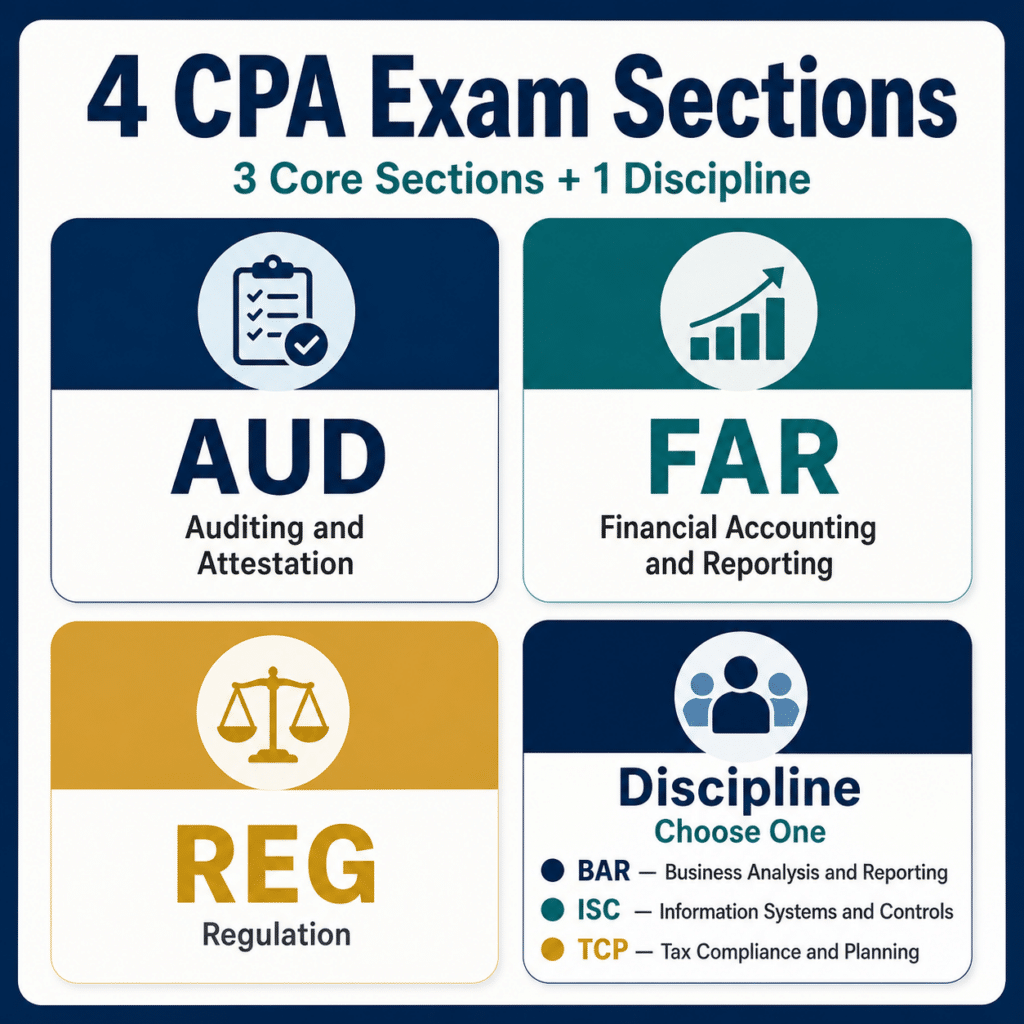
The four sections are:
- Auditing and Attestation (AUD)
- Financial Accounting and Reporting (FAR)
- Regulation (REG)
- One discipline: Business Analysis and Reporting (BAR), Information Systems and Controls (ISC), or Tax Compliance and Planning (TCP)
The exam is demanding, especially if you did not study accounting as an undergraduate. That does not mean it’s out of reach. It means your prep needs to be more intentional.
A CPA review course can help close knowledge gaps faster, particularly in FAR and REG. You’ll also want to understand the total CPA exam length before building a study schedule, because each section requires sustained concentration.
A realistic plan usually includes:
- 300 to 400 total study hours across all four sections for many candidates
- More time if you are learning accounting concepts from scratch
- A section-by-section schedule based on your strongest and weakest topics
- Practice with multiple-choice questions, task-based simulations, and timed exams
You aren’t automatically licensed once you pass the exam. You typically need to submit:
- Official transcripts
- Exam scores
- Work experience verification
- An application to your state board
- Ethics exam results, if your state requires one
- Fees and any background or identification documents
Some candidates qualify to sit for the exam before they meet all requirements for full licensure. That distinction matters. Exam eligibility and license eligibility are related, but they are not always identical.
Here’s the full path at a glance:
| Stage | Typical timeline | What to expect |
|---|---|---|
| Bachelor's degree | 4 years | Can be in a non-accounting field |
| Additional accounting/business credits | 6 to 24 months | Depends on transcript gaps |
| CPA Exam prep and testing | 12 to 18 months for many candidates | Varies by study pace and pass rate |
| Required work experience | 1 to 2 years in many states | Often under a licensed CPA |
| Licensure application | Weeks to months | Depends on state processing |
So, how to become a CPA without an accounting degree? Usually by adding the right credits, passing all four exam sections, and finishing supervised experience. Not quick, but very doable.
Use official sources whenever possible, including the AICPA exam overview and your state board’s application rules. Those details are where small mistakes turn into expensive delays.
Final Verdict
If you’re serious about how to become a CPA without an accounting degree, the path is practical: verify your state’s rules, close your credit gaps, pass the exam, and complete supervised experience. You do not need to start over with a new bachelor’s degree in most cases.
For a smart next step, compare your timeline with CPA study demands and explore prep resources that fit a working professional’s schedule.
Frequently Asked Questions
Yes, you can become a CPA without an accounting degree by meeting your state’s specific education, exam, and experience requirements. This often involves completing additional accounting and business courses beyond your bachelor’s degree.
Most states require a bachelor’s degree plus about 150 total semester hours, including 24 to 36 accounting credits and 18 to 30 business credits. Non-accounting majors usually complete these through post-baccalaureate certificates, individual courses, or relevant master’s programs.
The full process, including completing education gaps, exam prep, testing, and work experience, generally takes from 1.5 to 3 years. Your timeline depends on how many additional credits you need and your study pace.
Qualified experience usually includes 1 to 2 years in roles like public accounting, corporate accounting, tax preparation, internal audit, or government accounting, supervised by a licensed CPA. Entry roles often include staff accountant or audit associate positions.
The CPA exam has four sections—three core and one discipline-specific. Non-accounting majors often need 300 to 400 study hours and should consider review courses to cover accounting fundamentals, especially in Financial Accounting and Regulation.

Bryce Welker is a regular contributor to Forbes, Inc.com, YEC, and Business Insider. After graduating from San Diego State University, he went on to earn his Certified Public Accountant license and created CrushTheCPAexam.com to share his knowledge from reviewing hundreds of accounting courses while helping thousands of other accountants become CPAs. Bryce was named one of Accounting Today’s “Accountants To Watch” among other accolades. As Seen On Forbes