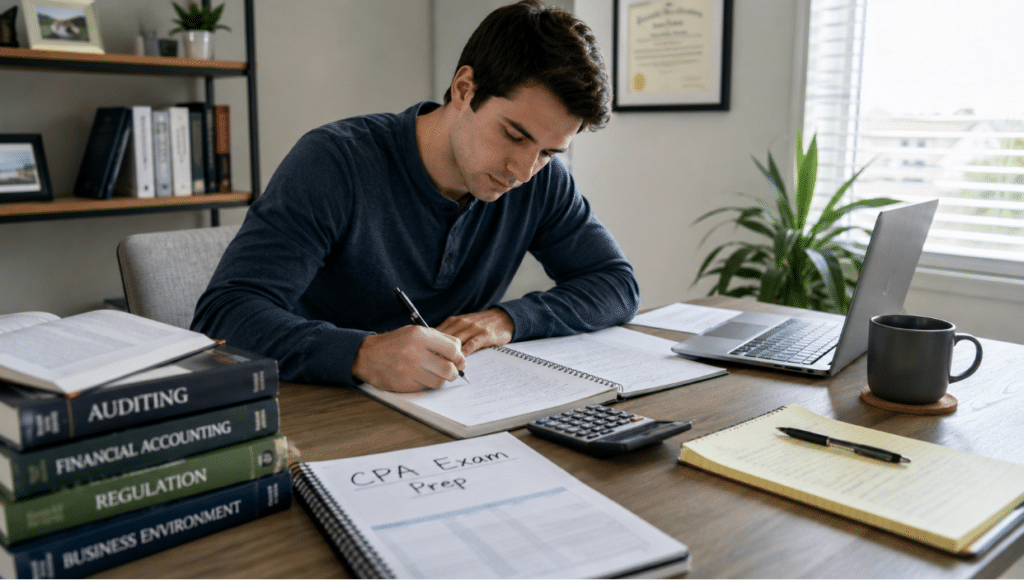
Education. Credits. CPA prep. Four exams. Work hours. More paperwork.
The CPA path gives candidates plenty of side quests to complete. It is not only “pass the exam and become licensed.” There are school rules, credit-hour rules, study time, test dates, experience requirements, and state board forms waiting at every turn.
So by the time the license is actually in hand… how much time has passed? It depends, but for most candidates, it is more likely years than months.
Below, I’ll break down the six major CPA steps, how long each one usually takes, and what can make the timeline move faster or drag out. Here’s what to know:
Key Takeaways
- Starting Point Matters: College, credits, and experience can change the timeline.
- The Exam Takes Time: Most candidates spend months passing all four sections.
- 150 Hours Can Add Time: Extra credits may be needed after a bachelor’s degree.
- Experience Can Overlap: Accounting work may count while studying.
- State Rules Decide The Details: Requirements vary by board.
Step 1: Finish The Education Requirements
Timeline: ~4 To 5 Years
The first chunk of time usually comes from school. Candidates often build their CPA eligibility through accounting, finance, business or related coursework. A bachelor’s degree usually takes about 4 years and includes around 120 credit hours. The catch is that many CPA candidates still need 150 total credit hours for licensure, which is about 30 credits beyond a typical bachelor’s degree.
Those extra credits can come from:
- A master’s degree
- Extra accounting classes
- Business electives
- Certificate programs
- Approved community college courses
Check the state board rules early. Some boards care about the exact accounting and business courses completed, not just the total number of credits. Missing transcripts, experience forms, or ethics records can also slow down approval later.
Step 2: Apply For The CPA Exam
Timeline: A Few Weeks To A Few Months
Once the education requirements are close enough, candidates apply to take the CPA Exam through the state board, NASBA, or the CPA Portal.
This step usually includes:
- Creating an account
- Sending official transcripts
- Paying application fees
- Getting education approved
- Waiting for a Notice to Schedule
The Notice to Schedule, or NTS, is what lets candidates schedule exam sections.This step is not hard, but it can slow the timeline down if transcripts are missing, classes do not match state rules, or the application gets delayed.
Step 3: Pass The CPA Exam
Timeline: 6 To 30 Months
AUD + FAR + REG + one Discipline, either BAR, ISC, or TCP. That is the exam flow.But the CPA Exam timeline is not just the 16 hours spent testing. Most of the time goes into studying, scheduling, waiting for scores, and retaking sections if needed.
| CPA Exam Step | Time Factor |
|---|---|
| Prep For Each Section | Many candidates spend several weeks to a few months studying for one section before sitting for it. |
| Schedule The Exam | Test dates depend on available Prometric appointments, so candidates may need to build in scheduling room. |
| Take Four Sections | Candidates must pass AUD, FAR, REG, and one Discipline section. Each section is 4 hours. |
| Wait For Scores | Score release timing can add waiting time, especially if candidates want results before scheduling the next attempt. |
| Retake If Needed | A failed section can add a few weeks or months for review, rescheduling, and another score wait. |
Many candidates spend around 6 to 18 months on the CPA Exam stage, depending on prep time, scheduling, score release timing, and retakes. Some spend up to 30.
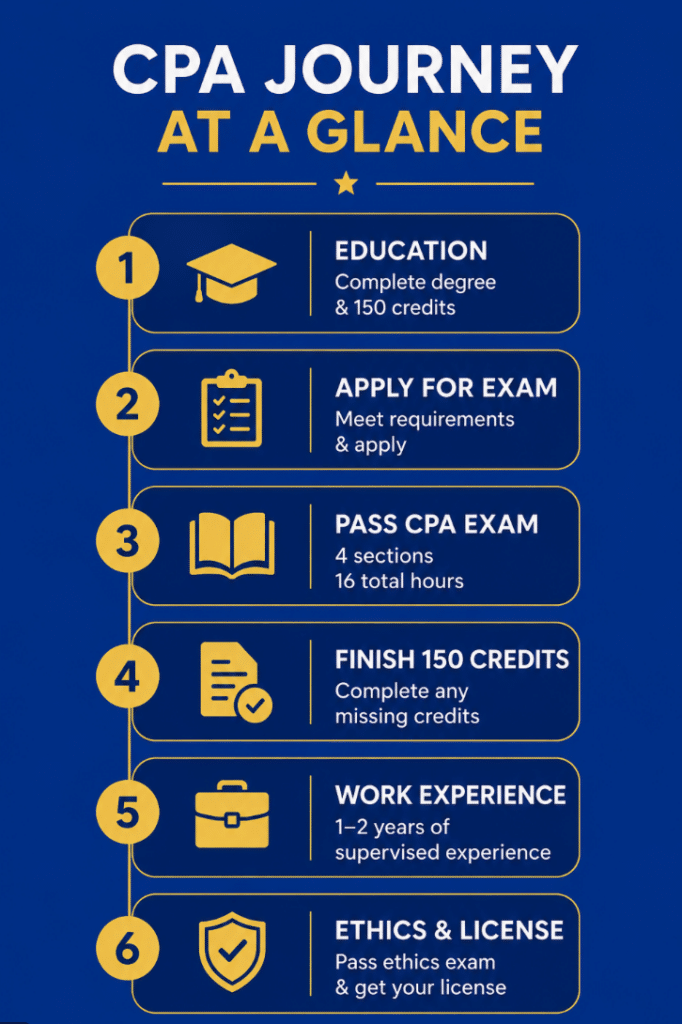
Step 4: Finish Any Missing 150-Hour Credits
Timeline: Anywhere up to 2 Years
Some candidates already have all 150 credit hours before taking the CPA Exam. Others finish the exam first and complete the remaining credits afterward, if their state allows it.
This step may take no extra time if the credits are already done. But if someone still needs 30 credit hours, it could add one semester, one year, or even two years, depending on the program and schedule.
This is why the CPA timeline can change so much from person to person. Someone with 150 hours already done may move straight into experience and licensing. Someone still finishing school may need extra time before the license can be approved.
Step 5: Complete The Work Experience Requirement
Timeline: Usually Around 1 Year
Passing the CPA Exam does not automatically make someone a CPA. Most states also require accounting experience. A common requirement is around one year of qualifying experience, often verified by a licensed CPA.
That experience may come from:
- Public accounting
- Tax
- Audit
- Financial reporting
- Government accounting
- Industry accounting
- Nonprofit accounting
- Advisory or consulting
This step can overlap with the exam timeline. For example, someone may study for the CPA Exam while already working in accounting. That can shorten the total timeline. But if someone has not started qualifying accounting work yet, this step may add about a year after the exam.
Step 6: Complete Ethics And Apply For The License
Timeline: A Few Weeks To A Few Months
Many states require an ethics course or ethics exam before issuing the CPA license. This part is usually not as intense as the CPA Exam, but it still has to be done.
After that, candidates submit the license application.
The final application usually includes:
- CPA Exam scores
- Final transcripts
- Proof of 150 credit hours
- Experience verification
- Ethics completion
- State forms
- Application fee
After everything is submitted, the state board reviews the file. If something is missing, approval can take longer. If everything is clean, this stage may only take a few weeks to a few months.
So, What Is The Realistic CPA Timeline?
Starting from scratch is the longest path, but it is also the most normal path. The shorter timelines mostly apply to candidates who already have major pieces finished, like extra credits, exam sections, or qualifying work experience. To compare prep options that can move you through the exam stage faster, see our best CPA review courses comparison.
Here’s the easiest way to look at it:
| Starting Point | Estimated Timeline |
|---|---|
| Starting College From Scratch | 5 - 7 Years |
| Already Have A Bachelor’s Degree | 1.5 - 3 Years |
| Already Have 150 Credits | 1 - 2 Years |
My Final Thoughts: How Long Does It Take To Become A CPA?
Becoming a CPA takes time, but the timeline makes more sense once it is broken into real steps. Education, exam prep, testing, experience, and licensing all add their own chunk of time.
Some candidates move faster if they already have credits or accounting experience. Others need a few extra years to finish school and pass each exam section. Either way, knowing the timeline upfront makes the whole process easier to plan.
FAQs
The timeline depends on the state’s licensure rules, how quickly candidates finish the required credit hours, their study pace for CPA Exam sections, and the time needed to complete supervised accounting experience.
In many states, candidates can sit for the CPA Exam after completing around 120 credit hours and finish the remaining credits later. That can help move the process along, but state rules vary.
The CPA Exam has four sections, with 16 total testing hours. Many candidates spend around 6 to 18 months passing all four sections because prep, scheduling, score releases, and retakes can add time. Many jurisdictions give candidates at least 30 months to pass the remaining sections after passing the first one, but the exact window can vary by state.
Yes, but candidates without an accounting degree often need extra accounting or business courses to meet state credit and subject requirements. That can extend the education phase compared to a traditional accounting major.
Candidates can shorten the timeline by checking state rules early, planning credit hours carefully, studying consistently, and starting qualifying accounting experience while preparing for the exam when allowed.

Bryce Welker is a regular contributor to Forbes, Inc.com, YEC, and Business Insider. After graduating from San Diego State University, he went on to earn his Certified Public Accountant license and created CrushTheCPAexam.com to share his knowledge from reviewing hundreds of accounting courses while helping thousands of other accountants become CPAs. Bryce was named one of Accounting Today’s “Accountants To Watch” among other accolades. As Seen On Forbes