Over half of an entire day…
That much time for one exam sounds insane until you realize you do not take it all at once.
The CPA exam is long and the setup can seem stressful if you do not understand how the time is split. So, before planning exam dates or study blocks, it helps to know what the full length really means and how each section fits into the bigger picture.
Today, I’ll break down how long the CPA exam takes, how each section is timed, and how to plan your schedule without making the process feel harder than it needs to.
Key Takeaways
- 16 Hours Total: The CPA exam is long, but it is split into smaller parts.
- Not One Test Day: Candidates do not take the full exam all at once.
- Four Sections: The exam includes Core sections and one Discipline section.
- Test Day Takes Time: The appointment can run longer than the exam clock.
- Planning Helps: A realistic schedule makes the process easier to manage.
What The 16-Hour CPA Exam Length Really Means
The CPA exam is 16 hours total, but that sounds worse than it works in real life. Candidates do not take all 16 hours in one sitting. The exam is split into four separate sections, and each section is scheduled on its own.
Quick breakdown:
- 4 exam sections
- 4 hours per section
- 16 total testing hours
So the challenge is not sitting in a testing center for 16 hours straight. It is planning when to take each section, how much time to leave between exams, and how much energy you can realistically give each one.
The Basics: CPA Exam Sections & Their Duration
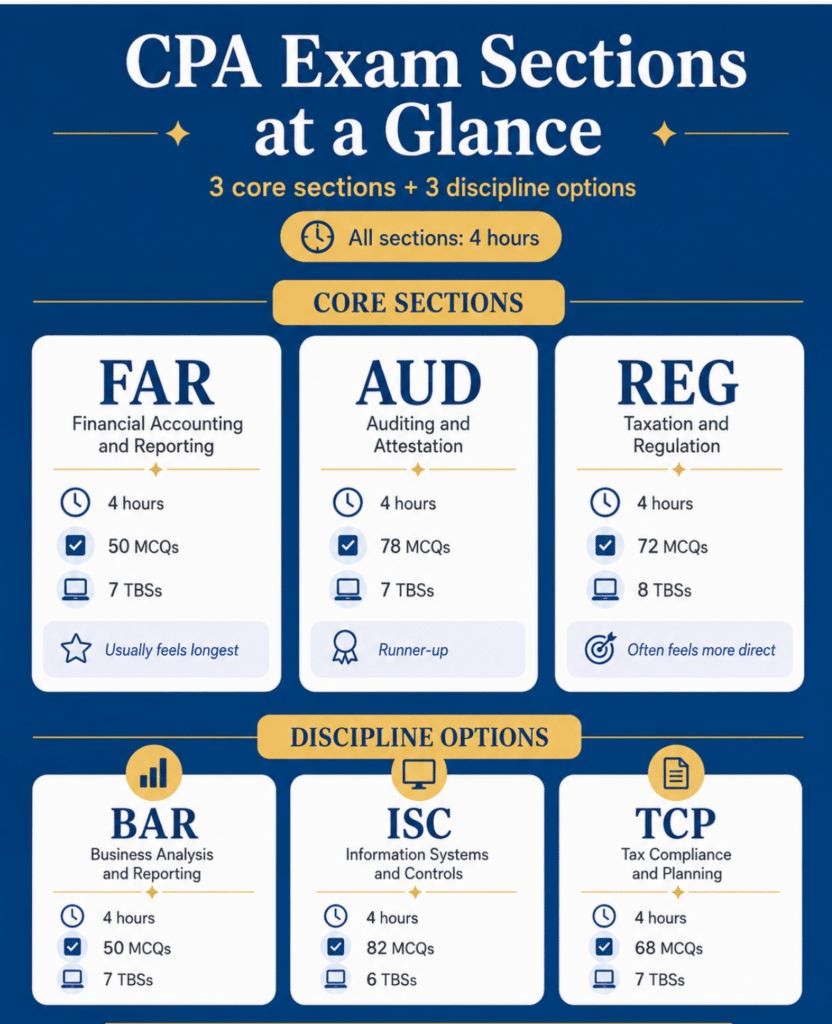
The CPA exam includes three Core sections: AUD, FAR, and REG, plus one Discipline section: BAR, ISC, or TCP.
Even though each section has the same time limit, they do not always feel the same in the chair. FAR can feel slower because it is broad and technical, AUD can drag because the questions are wordy, and REG may move faster for candidates who are comfortable with tax rules.
FAR: This Usually Feels The Longest
FAR is usually the section candidates expect to move slowly through. It has fewer multiple-choice questions than AUD or REG, but the material can feel heavier because it deals with financial reporting, statements, transactions, and accounting details.
That means the time pressure may come from the depth of the work, not just the number of questions.
- 50 multiple-choice questions
- 7 task-based simulations
- Broad financial reporting coverage
- Can feel slow because the content is dense
AUD: The Runner-Up
AUD can feel like the runner-up because it has a lot of questions and requires careful reading. The section is not always hard because of calculations; it is hard because several answer choices can sound possible.
This is the section where rushing can backfire fast.
- 78 multiple-choice questions
- 7 task-based simulations
- Heavy on reading and judgment
- Can feel slow because the answers are close
REG: This One Often Feels More Direct
REG still has a lot to get through, but it can feel more direct than FAR or AUD for some candidates. The section focuses on tax, business law, ethics, and professional responsibilities, so the questions may feel more rule-based.
That does not make it easy. It just means the time crunch may feel different.
- 72 multiple-choice questions
- 8 task-based simulations
- More rule-based than judgment-based
- Can move faster if tax concepts click
Discipline Section: Depends On What You Choose
The Discipline section is where the timing feel can really change. BAR may feel heavier because it leans into reporting and analysis, ISC has the most multiple-choice questions, and TCP may feel more direct for candidates who understand tax planning.
- BAR: 50 multiple-choice questions and 7 simulations
- ISC: 82 multiple-choice questions and 6 simulations
- TCP: 68 multiple-choice questions and 7 simulations.
What The 4-Hour Window Really Includes
The 4-hour timer is for the actual exam only. That includes answering questions, working through simulations, moving between testlets, and reviewing flagged answers.
But the full appointment can take longer because of check-in, ID verification, security, breaks, and sign-out.
Quick reality check:
- The exam itself is 4 hours
- The appointment may take longer
- Check-in and security add time
- Breaks can stretch the day
- You may feel drained afterward
💡 Pro Tip: Arrive earlier than the minimum check-in time so ID checks and security don’t take away from your focus before the exam.
How The CPA Exam Length Affects Test-Day Pacing
Since each CPA exam section is timed, pacing matters just as much as knowing the material. Candidates have to move through multiple-choice questions and simulations without spending too long on one part of the exam.
A simple way to think about it:
- Do not get stuck too long on one question
- Flag questions you want to review later
- Save enough time for simulations
- Watch the clock without panicking
- Practice timed sets before test day
The CPA exam is not just about finishing. It is about using the time well enough that you are not rushing through the hardest questions at the end.
How To Plan Around The CPA Exam Length
The CPA exam feels less overwhelming when candidates treat each section like its own test, not one giant 16-hour exam.
A realistic plan should match your actual schedule. Someone who can study 15 hours a week may move faster than someone who only has 6 to 8 hours, and that is fine. The goal is not to copy someone else’s timeline. It is to give yourself enough time to study, practice pacing, and review before test day.
A few things help:
- Pick an exam order that fits your strengths
- Built-in review time
- Practice with timed questions
- Avoid rushing just to move faster
The CPA exam can be a lot to take in, so the best schedule is one you can actually stick to.
Final Verdict: Is The CPA Exam Length Manageable?
The CPA exam is long, but it is not one giant test day.
Each section is its own 4-hour exam, so the process feels more manageable when candidates plan one section at a time. The real challenge is not just the total testing time. It is building enough study time, pacing practice, and review into the schedule before test day. A CPA review course can help map study hours to each section’s testing window.
FAQs
The CPA exam totals 16 testing hours across four separate sections. Candidates take three Core sections and one Discipline section, with each section scheduled as its own exam appointment.
Yes. Each CPA exam section has a 4-hour testing window. That timer covers the actual exam work, including multiple-choice questions, task-based simulations, testlet navigation, and any review done before submitting.
No. Candidates take the CPA exam one section at a time. That makes the process easier to plan because each test date can have its own study schedule, review period, and pacing strategy.
FAR usually takes the longest for many candidates because it covers a wide range of financial accounting topics. AUD, REG, and the Discipline section can still take serious time, but the difficulty depends on background and comfort with the material.
Timed practice matters most. Candidates should practice moving through multiple-choice questions and task-based simulations under exam-like conditions so the 4-hour window feels more familiar on test day.

Bryce Welker is a regular contributor to Forbes, Inc.com, YEC, and Business Insider. After graduating from San Diego State University, he went on to earn his Certified Public Accountant license and created CrushTheCPAexam.com to share his knowledge from reviewing hundreds of accounting courses while helping thousands of other accountants become CPAs. Bryce was named one of Accounting Today’s “Accountants To Watch” among other accolades. As Seen On Forbes