The FE exam is not something you should wing.
Some students pass the first time, but others fall short. Lack of studying may not even be the issue. Sometimes it is the prep course. If the course does not fit how you learn, what you need to review, or how much structure you need, you can waste a lot of time and money fast.
That is the annoying part. Every FE course claims it is the best, so you pay, dive in, and hope it actually works for you.
As a test prep reviewer, I went all in and tested four of the most talked-about FE courses to see what was actually helpful, what was overhyped, and who each course is really for.
Top FE Courses: At a Glance
- Best Complete Setup → School of PE FE Review
- Best Book-Heavy Prep → PPI2Pass FE Review Course
- Best for Civil Students → Civil Engineering Academy FE Course
- Best for Slow Problem Practice → Capstone Learning FE Review
Top FE Exam Study Materials Comparison
| #1 | #2 | #3 | #4 | #5 | #6 | |
| FE EXAM PREP COURSES |  |  |  |  |  |  |
| PRICE | $1,490 | $1,795 | $797 | $299 | $999 | $225 |
| DISCOUNT | Save $700 | Save $500 | ||||
| VIDEO LECTURES | 80 Hours | 16+ Hours | 90+ Modules | 35+ Hours | 45+ Hours (online) | None |
| PASSING GUARANTEE | Free Repeat Guarantee | |||||
| PRACTICE EXAMS | 2+ | 2 | 2 | 2 | 1 | 1 |
| FREE TRIAL | ||||||
| SUPPORT | ||||||
| GET STARTED | Start Now | Start Now | Start Now | Start Now | Start Now | Start Now |
1. School of PE: Best for Full FE Course Setup

School of PE made the most sense once I got into the Study Hub. I could see the lecture recordings, notes, flashcards, practice tools, and discussion areas without feeling like I had to open ten separate things first.
The course is not trying to be tiny. It covers FE Civil, Electrical, Mechanical, Environmental, Chemical, Industrial, and Other, with OnDemand and Live Online + OnDemand options. On-Demand is better if you want to start right away. Live Online + OnDemand is better if you need scheduled classes and instructor interaction.
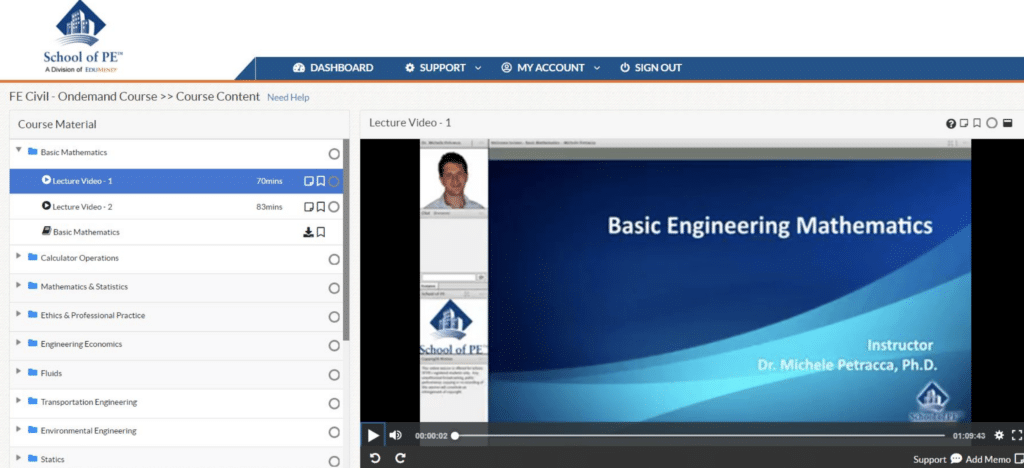
The only thing I would watch is the package setup. Some disciplines list more specific materials than others, and monthly access does not work the same as longer plans. Still, the School of PE came across as the strongest full-course option because the main tools are grouped into one place.
Inside the Dashboard
- Study Hub: I could find the main tools without digging.
- Lecture Recordings: Useful for reviewing topics more than once.
- Instructor Notes: Easier than trying to rebuild old class notes.
- Practice Problems: Good for checking what actually stuck.
- Flashcards: Better for quick formula and concept review.
- Instructor Connect: Helpful if I got stuck on a problem.
- Discussion Forum: An extra place to see what other students ask.
- Study Plan: Gives the course more direction than a loose checklist.
- FE Disciplines: Civil, Electrical, Mechanical, Environmental, Chemical, Industrial, and Other.
- Access Options: 4-month, 6-month, 12-month, and monthly options are listed.
Pros
✅ The Study Hub kept the course from feeling scattered
✅ I could switch between videos, notes, and practice easily
✅ Live Online adds structure if self-paced prep is not enough
✅ The course works for more than just FE Civil students
Cons
❌ Monthly access does not get the same guarantee benefits
❌ Some FE tracks list more included materials than others
❌ The Study Hub may feel crowded at first
Will School of PE Work?
School of PE is strongest when you want the course to keep everything organized for you. The Study Hub made it easier to move between videos, notes, flashcards, practice problems, and support without piecing together a plan alone. Just check your exact FE discipline and access length first because the included materials are not identical across every option.
2. PPI FE Review: Best for Book-Heavy FE Prep

PPI is the more textbook-heavy FE course, but that is not automatically a bad thing. The Learning Hub is built around review manuals, Qbank practice, web books, diagnostic exams, and full-length practice exams, so it works best if you want a deeper study setup instead of a quick video course.
I liked the Qbank because I could make targeted quizzes instead of only following preset assignments. The web books were also useful when a short explanation was not enough, and I needed the actual topic review behind it.

The tradeoff is that PPI can feel heavier than something like School of PE. If you want a lighter course, it may feel like too much. But if you want detailed materials, practice exams, and a more academic review style, the setup makes sense.
Inside the PPI Learning Hub
- Learning Hub: Main area for Qbank, web books, exams, and study tasks.
- Qbank: Lets you build custom quizzes by topic.
- Activity Library: Makes it easier to find study materials.
- Web Books: Helpful when I needed more than a short explanation.
- Diagnostic Exams: Good for spotting weak areas early.
- Full-Length Practice Exams: Useful for timing and stamina.
- Live Online Lectures: Adds structure for students who need a schedule.
- Office Hours: Extra help outside the live class.
- On-Demand Lectures: Better for flexible video review.
- Passing Guarantee: Available with eligible Live Online FE courses.
Pros
✅ The Qbank made targeted practice easy
✅ The web books added more depth to harder topics
✅ Diagnostic exams helped point out weak areas
✅ Live Online includes office-hour support
Cons
❌ The course can feel heavy if you want a quick review
❌ Self-study students need to stay organized
❌ The amount of material may feel like overkill
Is PPI Best for You?
PPI’s Learning Hub gives you a lot to work with, especially between the Qbank, web books, diagnostic exams, and full-length practice exams. It is not the easiest option to skim, but it works well for students who want depth, harder practice, and a more structured study library.
3. Civil Engineering Academy: Best for Civil FE Students

Civil Engineering Academy was easy to place because it is clearly for Civil FE students, not everyone. I started with the problem walkthroughs since that is the part that matters most here. The videos worked best when I could pause, follow the steps, and use the slides instead of trying to take notes from nothing.
The CBT simulator was also useful because it made practice feel closer to exam mode than random loose questions. That said, the course is not as polished as bigger platforms, and the support setup leans more basic. I also would not use it unless I was taking Civil.
CEA makes the most sense for visual learners who want to see problems worked out slowly and clearly.
CEA Course Perks
- Civil FE Modules: Easy to place because everything stays focused on Civil.
- Problem Walkthroughs: The strongest part. I could follow the steps instead of guessing what happened between lines.
- Downloadable Slides: Helpful because I did not have to take notes from a blank page.
- Practice Exams: Two 110-question exams for longer review.
- CBT Simulator: Better for pacing and exam feel than loose practice sets.
- Live Workshops: Useful if you learn better by watching problems get worked out.
- Private Facebook Group: Good for extra questions, but not everyone likes group-based support.
- Instructor Support: Helpful if one solution still does not click.
Pros
✅ The problem walkthroughs were easy to follow
✅ Downloadable slides made the videos less annoying to use
✅ CBT practice helped with timing, not just content
✅ Strong fit for visual Civil FE learners
Cons
❌ Only useful if you are taking Civil FE
❌ The platform is not as polished as bigger providers
❌ Not the best fit if you want a huge test bank
Where CEA Lands
CEA is a solid pick for Civil FE students who learn best by watching problems get solved. The walkthroughs and CBT simulator are the strongest parts. It is not polished like bigger platforms, and it is useless outside Civil, but it does a good job keeping the focus on practice instead of extra course clutter.
GO TO CIVIL ENGINEERING ACADEMY FE REVIEW
4. Capstone Learning: Best for Slow Problem Practice

Capstone was not the smoothest course to click through, but the problem setup had a point. I tried it more like a practice tool than a full study dashboard. The best part was seeing problems broken down in a slower, more exact way instead of getting a quick answer and moving on.
It worked better when I treated it like extra problem training, not my main FE course. The layout is plain, and it does not have the same “everything is in one place” feel as School of PE or PPI. Still, if you get stuck because FE solutions move too fast, Capstone’s slower solving style can help.
Standout Tools
- Problem Sets: Better for working through steps than quick review.
- Instructional Modules: Helpful, but not the most modern-looking lessons.
- Sample Exam: Good for checking how the practice carries over.
- FE Core Option: Smaller option if you do not want the full course.
- Discipline Options: Civil, Mechanical, Other, Chemical, and Electrical.
- Tutor Support: Useful, but not the main reason to pick it.
- CBT Focus: More about exam-style solving than a flashy platform.
Pros
✅ The solved problems were the clearest part
✅ Good for students who need slower explanations
✅ FE Core gives a cheaper starting point
✅ Helpful as extra practice beside another course
Cons
❌ The platform feels dated
❌ Not much live-class or community support
❌ The problem-heavy style will not fit everyone
Final Word on Capstone
Capstone is not the course I’d call exciting, but it has a purpose. It works best for students who need slower problem breakdowns and extra CBT-style practice. The weak spot is the platform experience. It feels dated and less complete than bigger providers.
What to Look for in an FE Review Course
- Practice that matches the exam: The FE has 110 questions, so I cared more about realistic practice than a giant pile of random problems.
- Clear explanations: A practice question only helps if the answer breakdown shows what happened.
- Discipline fit: Civil, Mechanical, Electrical, Chemical, Environmental, Industrial, and Other are not the same exam. The course needs to match yours.
- Study structure: Some students need live classes. Others just need On-Demand videos and a question bank.
- Good review tools: Flashcards, notes, study plans, CBT practice, and full exams mattered more than extra features I would never open.
- Enough support: Instructor help is useful if you get stuck, but not every student needs a full live class setup.
My Final Verdict
The best FE review course depends on how much structure you need. School of PE is the safest overall pick if you want a full course that keeps the study process organized. PPI is better for students who want a deeper review and do not mind harder materials. Civil Engineering Academy makes the most sense for Civil FE students who need walkthroughs. Capstone is best as extra problem practice, not a fully polished course.
FAQs
The FE exam is the Fundamentals of Engineering exam. It is usually one of the first major steps toward becoming a licensed professional engineer.
FE exam preparation is dependent upon individuality. The recommended time is usually between 14 and 24 months, depending on the FE exam prep needed. FE exam review courses can help cut this time down dramatically, especially when you get access from one of the best FE exam prep companies.
The most effective preparation involves a combination of studying FE review courses like School of PE Review, practicing with course materials, and taking practice exams. Tailoring your study plan to focus on areas where you need the most improvement can also significantly enhance your readiness for the exam.
NCEES allows you to take the FE exam once during any two-month testing window, and up to three times in a twelve-month period. There is a waiting period to reapply if you need to take the exam additional times.
No, work experience is not required to sit for the FE exam. The exam is designed to test your knowledge of fundamental engineering principles typically covered in an engineering degree program.
If you fail the FE exam, you can retake it after waiting for the next testing window. Utilizing this time to review your weakest areas with additional study materials or review courses can improve your chances of passing on your next attempt.
Feeling ready for the FE exam often comes from consistent performance on practice tests and comfort with the exam’s reference materials. If you’re scoring well on practice exams and feel confident navigating the provided reference handbook, you’re likely ready to take the exam.

Bryce Welker is a regular contributor to Forbes, Inc.com, YEC, and Business Insider. After graduating from San Diego State University, he went on to earn his Certified Public Accountant license and created CrushTheCPAexam.com to share his knowledge from reviewing hundreds of accounting courses while helping thousands of other accountants become CPAs. Bryce was named one of Accounting Today’s “Accountants To Watch” among other accolades. As Seen On Forbes