Choosing between EA and CPA sounds simple… until you realize the wrong choice can cost you years.
Not because one path is “bad.”
On the contrary, both are great, each with their own advantages. One is easier to start (and still has impressive earning potential, mind you), while the other can pay off a lot more over time.
So, do you go with the faster path and start earning sooner? Or do you take the harder route because it can open bigger doors later?

Or maybe, you do a bit of both.
I broke down EA vs. CPA career paths based on the things that matter most, like barriers to entry, salary, career growth, and long-term upside. Let’s get into it.
Key Takeaways
- CPA Has The Better Long Game: CPA usually wins on salary, advancement, and overall career flexibility.
- EA Is Easier To Start: EA has a much lower barrier to entry, which makes it a faster way into tax work.
- Starting Pay Usually Favors CPA: EAs can earn solid money, but CPAs usually start at a higher pay level.
- CPA Is Better For Moving Up: If you want management or leadership roles later, CPA is usually the stronger credential.
- EA Can Be A Smart First Step: For some people, EA is a practical way to gain experience before going after the CPA.
EA vs. CPA: The Short Answer
For most people, CPA is the better long-term career path. It usually leads to better pay, better promotion odds, and more ways to move up. But EA is the easier door to open. If you want to get into paid tax work faster, EA is the more realistic starting point.
Barrier To Entry: EA Is Much Easier
This is where EA has a clear edge.
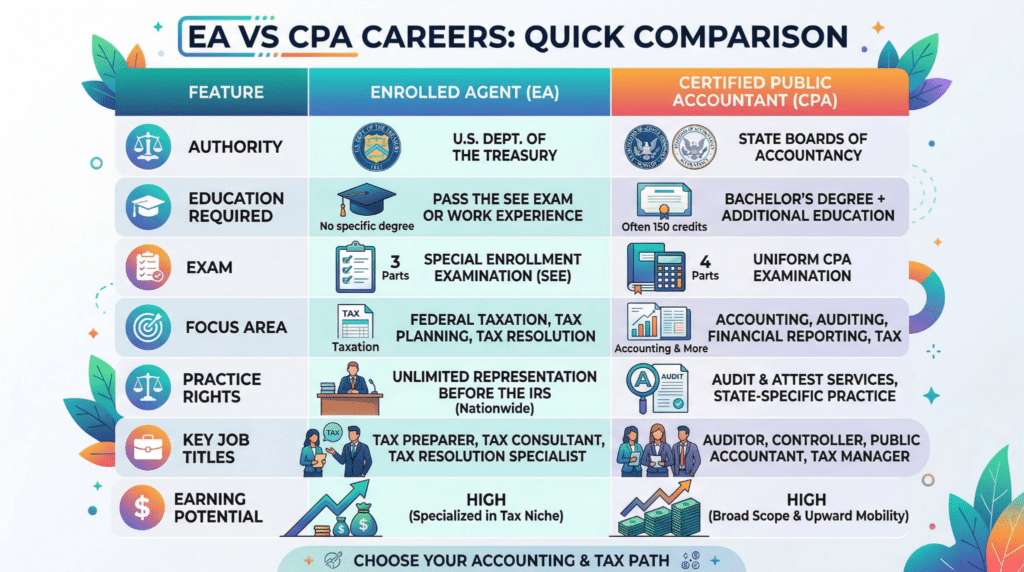
The IRS says most people become an EA by getting a PTIN, passing a three-part IRS exam, and clearing a suitability check. There is no standard IRS rule saying you need a college degree first.
CPA is a much heavier lift. NASBA says CPA requirements depend on the state, but the path is built around education, the CPA Exam, and work experience. NASBA also notes that some states require 150 semester hours just to qualify for the exam, while others require less. AICPA says the exam itself includes three Core sections and one Discipline section.
That’s why I think EA wins the entry battle by a mile. It’s simpler, it’s faster, and most importantly, it lets you start earning sooner.
Salary: CPA Usually Starts Higher
This is the part that really matters to a lot of people, and honestly, it should.
Current salary trackers put the average EA salary at about $71,805 on Indeed and $72,507 on ZipRecruiter. That lines up with the idea that EA pay is solid, but not usually at the CPA level right away.
By comparison, current salary trackers put the average CPA salary at about $96,897 on Indeed and $91,980 on ZipRecruiter. On the broader government side, the Bureau of Labor Statistics says accountants and auditors had a median annual wage of $81,680 in May 2024.
So no, I wouldn’t write that every CPA is “guaranteed” $80K on day one. That’s too absolute. But I do think the bigger point is clear: CPA has the stronger pay floor and the stronger earning path from the start.
Career Growth: CPA Has the Better Ceiling
This is the other big reason CPA usually wins.
A CPA can work in tax, but that’s only one lane. The credential also connects to audit, financial reporting, accounting, advisory, and other finance roles. That broader lane matters because it gives you more shots at raises, title jumps, and management jobs later on.
And if you want to climb, CPA is usually the better tool for that. The Bureau of Labor Statistics says financial managers, a role that often grows out of accounting and finance experience, had a median annual wage of $161,700 in May 2024 and typically need 5 years or more of related work experience.
That’s a huge difference. EA can absolutely turn into a strong career. But CPA is usually better if your goal is to move into senior roles, run teams, or chase controller and finance-management jobs. That’s where the ceiling gets a lot higher.
Why EA Still Makes Sense
EA is not the “bad” option. It’s the lower-barrier option.
If you don’t have the time, money, or credits for the CPA path yet, EA can be a smart move. You can get into tax work faster, build real experience, and start making money while you figure out whether you want to keep going. Since CPA licensure also depends on work experience and state-specific rules, starting in tax can help you build a stronger base before taking on the CPA track.
I think that’s why the EA-to-CPA path makes so much sense for some people. You don’t have to sit around waiting until every part of your CPA plan is perfect. You can get moving first. Then you can build from there.
Who Should Choose EA?
EA makes more sense if you:
- want the fastest path into tax work
- don’t want to deal with a long state licensing process yet
- need to start earning sooner
- like the idea of using tax work as a stepping-stone
Those are not small advantages. For the right person, they’re huge.
Who Should Choose CPA?
CPA makes more sense if you:
- want the highest long-term earning potential
- want more job options outside tax
- care about moving into management later
- can handle a tougher, longer path up front
That’s why I’d still give CPA the overall win. It asks for more, but it usually gives more back. Before you commit, see our best CPA review courses breakdown or, if EA is more your speed, the top enrolled agent courses comparison.
Final Verdict
If you want a better career path overall, go with a CPA.
If you want an easier way to get into the field, go with EA.
That’s the cleanest way to say it. EA is the easier entry point. CPA is the better long game. So if you’re trying to choose the path with the bigger upside, I’d pick CPA. If you need a faster launch, EA is the smarter first move.
FAQs
CPA is usually better for earning more, especially early on and over the long run. EA pay can still be strong, but CPA tends to have a higher ceiling.
Yes, in most cases it is. The EA path is much simpler, while the CPA path usually takes more school, more testing, and more time.
Yes, and that’s a pretty practical path for some people. It lets you start working sooner while building experience for the longer CPA route.
Mostly, yes. EA is strongest for tax prep, tax planning, and IRS-related work, while CPA can lead to a wider range of accounting and finance roles.
Usually, yes. CPA is more likely to help you move into leadership roles because it’s tied to broader accounting and finance career paths.

Bryce Welker is a regular contributor to Forbes, Inc.com, YEC, and Business Insider. After graduating from San Diego State University, he went on to earn his Certified Public Accountant license and created CrushTheCPAexam.com to share his knowledge from reviewing hundreds of accounting courses while helping thousands of other accountants become CPAs. Bryce was named one of Accounting Today’s “Accountants To Watch” among other accolades. As Seen On Forbes