Becoming an enrolled agent is a rare opportunity to work in finance without needing a bachelor’s degree.
But to unlock this rewarding—and often lucrative—career path, you’ll need to pass the three-part enrolled agent exam first.
As you may have already guessed, it’s no easy feat.
That said, understanding the format, timelines, and study tips can give you a boost before you even start studying. Here are the highlights worth knowing.
Key Takeaways
- No Degree Required: The enrolled agent exam is an IRS credential that gives you unlimited taxpayer representation rights, and you do not need a college degree to qualify.
- Three-Part Exam: The test is split into Individuals, Businesses, and Representation, Practices, and Procedures, with each part covering a different area of tax knowledge.
- Three-Year Deadline: Candidates must pass all three parts within three years, with testing typically available each year from May through February.
- IRS Review Comes Next: After passing the exam and submitting Form 23, candidates go through an IRS suitability check, so tax compliance and background still matter.
- Preparation Helps A Lot: Building a study plan before registering can make the process easier to manage and lower the odds of rushed retakes.
What The Enrolled Agent Exam Is and Who Should Take It
The enrolled agent exam, also called the Special Enrollment Examination (SEE), is the IRS test for people who want to become Enrolled Agents. Passing it can lead to unlimited representation rights before the IRS, which means you can represent individuals, businesses, and other taxpayers.
I think this exam makes sense for:
- Tax preparers who want a stronger credential
- Bookkeepers or accountants who want to grow
- Career changers interested in tax work
- Anyone who wants an IRS-recognized license without becoming a CPA
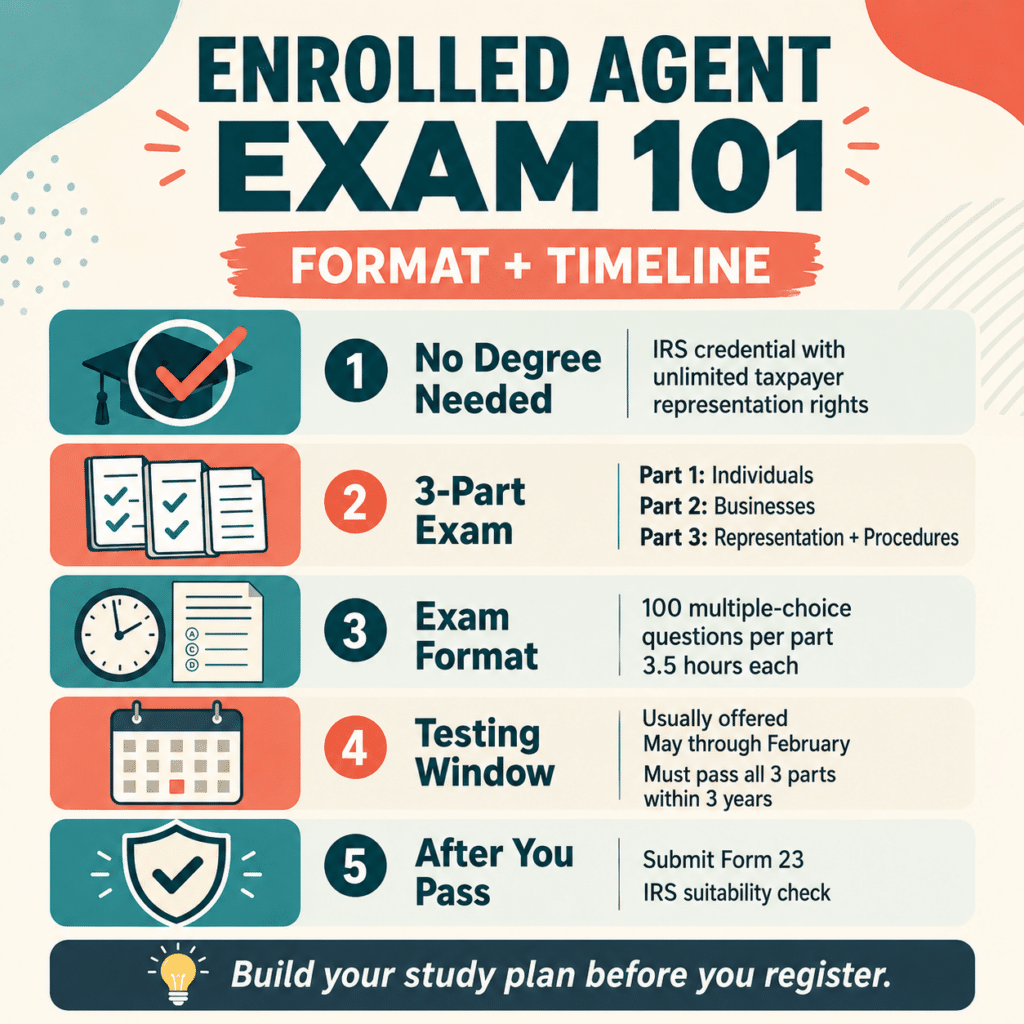
You don’t need a college degree to take it. And you don’t need prior tax job experience just to sit for the exam. That lower barrier to entry is a big reason people search for the enrolled agent exam in the first place.
How The Special Enrollment Examination Is Structured
The SEE has three separate parts, and you can take them one at a time. That’s helpful, because trying to swallow all of federal tax law in one sitting sounds like a bad weekend.
Here’s the basic format:
- 100 multiple-choice questions per part
- 85 scored questions and 15 experimental questions
- 3.5 hours total for each part
- Delivered in two 50-question sections
- Optional 15-minute break between sections
The IRS updates the exam cycle each year, so testing is generally offered from May 1 through the end of February. March and April are usually blackout months for updates.
You must pass all three parts within three years. Testing is handled through PSI at approved test centers.
What Each Part Of The Exam Covers
Each section of the enrolled agent exam focuses on a different side of tax practice. I’d treat them like three related exams, not one giant monster. That makes study planning much easier.
Part 1: Individuals
Part 1 covers individual tax matters. This includes taxpayer data, income, assets, deductions, credits, and general tax rules for individuals. It also covers advising taxpayers and some specialized returns.
If you’ve prepared Form 1040 returns before, this part may feel the most familiar. Still, don’t get too comfortable. The exam can test small details that are easy to miss.
Part 2: Businesses
Part 2 moves into business taxation. It covers business entities, business tax prep, and specialized returns and taxpayers. Expect topics tied to how different business structures are taxed and reported.
In my view, this part can feel trickier because there are more moving pieces. A sole proprietorship is one thing. Partnerships and corporations? That’s where people start reaching for extra coffee.
Part 3: Representation, Practices, And Procedures
Part 3 is about working with the IRS. It covers practices and procedures, representation before the IRS, specific representation areas, and filing processes.
This section matters because being an Enrolled Agent isn’t just about preparing returns. It’s also about knowing how to handle audits, communicate with the IRS, and follow professional rules. If you want to actually use the credential, Part 3 is a big deal.
How To Register, Schedule, And Pay For The Exam
The sign-up process is pretty straightforward.
- Get a PTIN through IRS.gov.
- Create an account through PSI’s SEE portal and review the Candidate Bulletin.
- Schedule your exam online or by phone.
- Pay the exam fee for each part.
After you pass all parts, you’re not done yet. You’ll need to submit Form 23 to apply for enrollment, and the IRS will complete a suitability check. That includes reviewing tax compliance and background issues.
My advice: before you book anything, map out your study plan first. A test date is motivating. A rushed retake fee is not. If you want a side-by-side look at the leading enrolled agent prep options, check out our top enrolled agent courses comparison.
FAQs
The Enrolled Agent exam, or Special Enrollment Examination (SEE), is an IRS credentialing test that grants unlimited rights to represent taxpayers before the IRS. It’s ideal for tax preparers, accountants, career changers, and those wanting IRS recognition without a college degree.
The exam has three parts, each with 100 multiple-choice questions split into two 50-question sections over 3.5 hours. Testing is offered from May 1 through February at PSI centers, with a blackout period in March and April for updates.
Part 1 covers individual tax matters, Part 2 focuses on business taxation, and Part 3 addresses IRS representation, practices, and procedures, including audits and filing processes.
Yes, the Enrolled Agent exam does not require a college degree or prior tax job experience, making it accessible for beginners interested in IRS-recognized tax credentials.
Treat each part as a separate exam focusing on its distinct topics. Plan a study schedule before booking test dates to avoid rushed retakes and to cover key details in federal tax law thoroughly.

Bryce Welker is a regular contributor to Forbes, Inc.com, YEC, and Business Insider. After graduating from San Diego State University, he went on to earn his Certified Public Accountant license and created CrushTheCPAexam.com to share his knowledge from reviewing hundreds of accounting courses while helping thousands of other accountants become CPAs. Bryce was named one of Accounting Today’s “Accountants To Watch” among other accolades. As Seen On Forbes