Wondering how much it really takes to become an Enrolled Agent?
Spoiler alert: it’s not just “take the exam and pass.”
There are a few IRS requirements before and after exam day, and missing one can slow the whole process down.
So if you’re comparing accounting and tax careers, in this guide, I will break down the full process, including the timeline, costs, and what your career can look like once you become an Enrolled Agent.
Let’s get started!
Key Takeaways
- Two Paths: Most people test in, while some qualify through IRS work.
- No Degree: You can start without a college background.
- EA Exam: The SEE is tax-focused, not general accounting.
- Real Timeline: Your pace depends on study time and IRS processing.
- Tax Career: EA fits people who want IRS-focused tax work.
Meet The Enrolled Agent Requirements And Choose Your Eligibility Path
By becoming an Enrolled Agent, you’ll be able to represent taxpayers before the IRS in tax matters like audits, collections, and appeals.
There are two ways to become an Enrolled Agent:
- Pass the Special Enrollment Examination (SEE)
- Qualify through past IRS work experience
Enrolled Agent Eligibility Path Comparison
| Eligibility path | Who it fits | Main requirement | Typical timeline |
|---|---|---|---|
| SEE exam path | Students, career changers, tax preparers, bookkeepers, accountants | Pass all 3 exam parts and apply | Often 3 to 12 months, depending on study pace |
| IRS experience path | Former qualifying IRS employees | 5 years of relevant IRS service | Depends on prior work history |
For most readers, the SEE route is the one that matters. It’s the accessible path, and you can start without waiting for a degree program.
The Basic Enrolled Agent Requirements
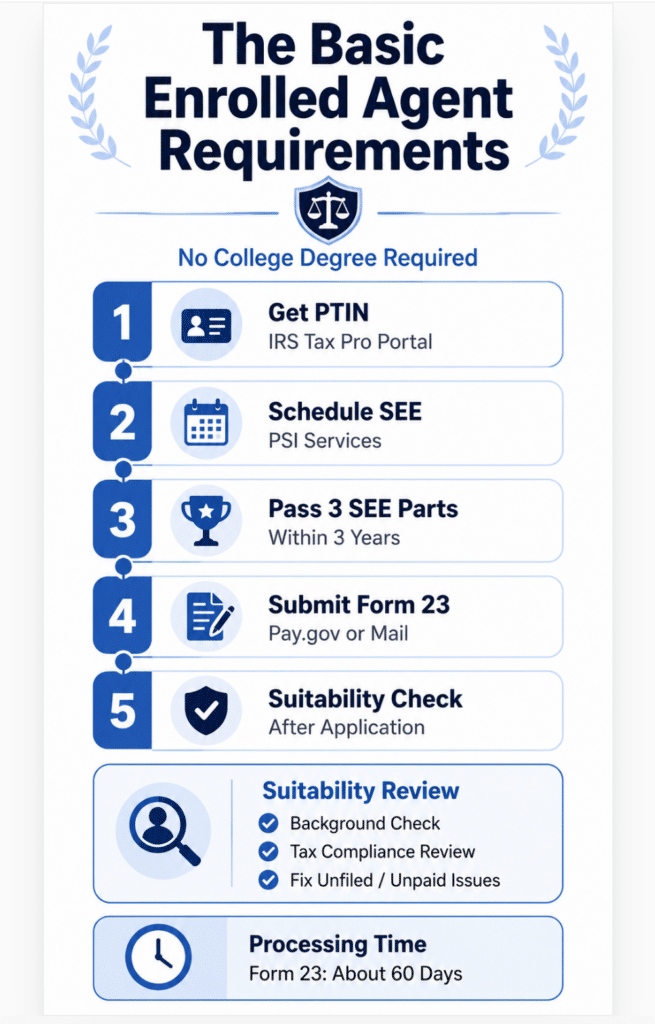
You do not need a college degree to become an Enrolled Agent. For most candidates, the process usually looks like this:
- Apply for a PTIN through the IRS tax professional portal.
- Create a testing account with PSI Services and schedule the SEE.
- Pass all three parts of the SEE within three years.
- Submit Form 23 through Pay.gov or by mail.
- Complete the IRS suitability check after submitting your enrollment application.
The suitability review can include a background check and a review of your tax compliance history. If you owe taxes, have unfiled returns, or have other unresolved issues, fix those before you apply.
Form 23 processing generally takes about 60 days after the IRS receives your application.
Know What The SEE Covers
The Special Enrollment Examination (SEE) has three parts:
- Individuals
- Businesses
- Representation, Practices, and Procedures
You can take the parts in any order, but most people do better studying one section at a time. The exam is focused on federal tax rules and IRS procedures, so it is not the same as a general accounting test.
Plan For The Cost And Timeline
There are a few required costs to plan for before adding study materials, a top EA prep course, or possible retakes.
Estimated Enrolled Agent Costs
| Item | Typical Cost |
|---|---|
| PTIN application or renewal | $19.75 |
| SEE exam fee per part | $317 |
| All three SEE parts | $951 |
| Form 23 enrollment application | $140 |
That makes the basic total around $1,110.75, not counting study materials, prep courses, or retakes.
Most candidates finish the process in 3 to 12 months, depending on how much time they have to study and how quickly they schedule the three exam parts.
Pro Study Tips that Actually Help
A lot of people underestimate the exam because the EA path doesn’t require a degree. That’s a mistake. The SEE is passable, but only if you prepare well.
My favorite study tips for exam day success:
- Start with one exam part, not all three at once
- Study tax concepts and IRS procedures separately
- Take timed practice exams to build speed
- Consider an EA prep course if you need structure or accountability
If you’re balancing a job and family responsibilities, schedule your test dates early. Deadlines feel more real once they’re on your calendar.
Build Your EA Career and Maintain Your Credential
After you become an Enrolled Agent, you have to complete continuing education to stay active. The IRS requires:
- 72 hours of continuing education every three years
- At least 16 hours each year
- At least 2 hours of ethics each year
- Use an IRS-approved Continuing Education provider
This ongoing education requirement is manageable, but it’s not optional. Tax law changes constantly, and the IRS expects EAs to stay current.
Bottom Line
The real final step is putting the plan into motion. You’ve seen the requirements, the exam path, the application process, and the IRS review, so now it’s less of a mystery and more of a checklist.
Becoming an Enrolled Agent is not about doing everything perfectly or having every detail figured out on day one. It is about completing the IRS requirements in the right order, preparing for the SEE, and submitting your application when you’re ready. Start with the first requirement, build a study plan you can realistically follow, and keep moving through the process from there.
FAQs
To become an Enrolled Agent, you must obtain a valid Preparer Tax Identification Number (PTIN), pass all three parts of the IRS Special Enrollment Examination (SEE) within three years or qualify through prior IRS experience, submit Form 23 with an application fee, and pass an IRS suitability check.
Most candidates take between 3 and 12 months to become Enrolled Agents via the exam path. This includes time to get your PTIN, study for and pass the three SEE parts, and complete the IRS application process.
The SEE includes three parts: Individuals (individual tax returns), Businesses (business tax returns), and Representation, Practices, and Procedures (IRS rules and taxpayer rights). Each part has 100 questions, and you must pass all three.
No college degree is required to become an Enrolled Agent. This credential is focused specifically on federal tax expertise and is accessible for career changers, tax preparers, and bookkeepers looking for a faster tax representation credential.
Most people consider the EA easier than the CPA because it is more focused on tax and does not require a college degree. The CPA path is broader and usually has more education requirements.

Bryce Welker is a regular contributor to Forbes, Inc.com, YEC, and Business Insider. After graduating from San Diego State University, he went on to earn his Certified Public Accountant license and created CrushTheCPAexam.com to share his knowledge from reviewing hundreds of accounting courses while helping thousands of other accountants become CPAs. Bryce was named one of Accounting Today’s “Accountants To Watch” among other accolades. As Seen On Forbes