Not everyone can become a certified management accountant, but if you can, it may be worth pursuing. According to the Institute of Management Accountants, it’s a career path that earns successful candidates over for every hour of study.
In this guide, I’ll explain the CMA certification requirements you actually need to know if you want to (or qualify to) pursue this career path.
So, without further ado, let’s get you closer to being certification-ready.
Key Takeaways

- Know The Core Requirements: CMA certification requires IMA membership, passing both exam parts, a qualifying degree or approved professional certification, and two years of relevant work experience.
- You Can Start Before Finishing Everything: You can take the CMA exam before completing the education or experience requirements, but full certification only comes after all criteria are met and verified.
- The Exam Has Two Parts: The CMA exam is split into two sections covering financial planning, performance, analytics, and strategic financial management.
- Certification Has To Be Maintained: To keep the CMA active, you need annual continuing education, ethics training, and current IMA membership.
- The Full Timeline Takes Planning: The process can take several years when you factor in education, exam prep, and the required work experience.
How to Qualify For The CMA Certification
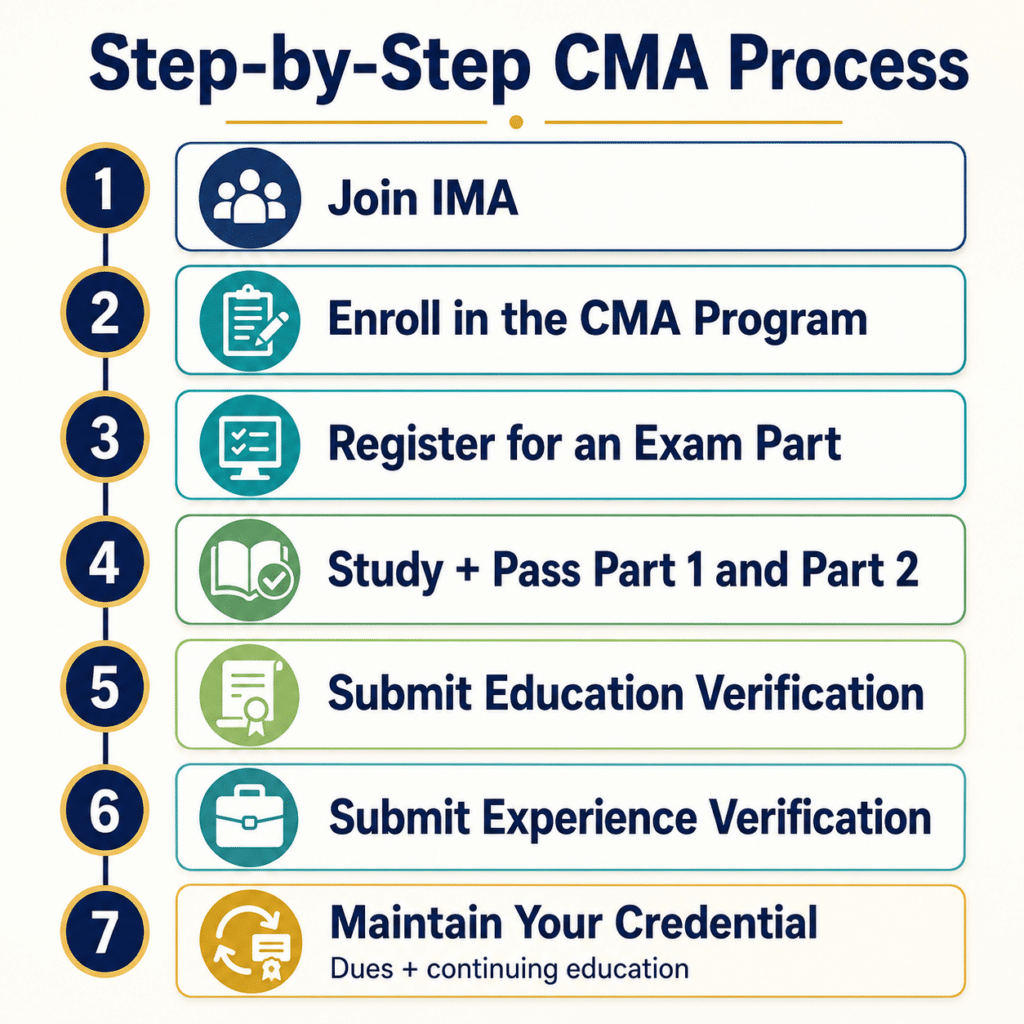
To qualify for the CMA certification, you need to meet four core requirements:
- Join the Institute of Management Accountants (IMA)
- Enter the CMA program and pay the entrance fee
- Pass both parts of the CMA exam
- Meet the education and experience requirements
A common point of confusion: you can usually take the exam before you finish the education or experience requirements, but you cannot receive the full CMA credential until those requirements are verified by the Institute of Certified Management Accountants (ICMA), the certification arm of IMA.
That makes the CMA more flexible than many people expect. If you’re still in school or building experience, you may be able to start the exam process now and complete the remaining pieces later.
How To Meet The Education, Experience, and Membership Requirements
The biggest part of understanding CMA certification requirements is knowing what counts, when it counts, and how long the full path really takes.
Education Requirement
To earn the CMA, you must have a bachelor’s degree from an accredited college or university or an approved professional certification accepted by IMA. The degree does not have to be in accounting or finance, though those majors can obviously help with exam prep.
If your degree is from a non-US institution, IMA may require evaluation by an independent credential service to confirm equivalency. The key issue is accreditation and recognition, not just whether you completed a program.
Experience Requirement
You also need two continuous years of full-time professional experience in management accounting or financial management. This experience can generally be completed before or within a set period after passing the exam, based on IMA rules.
Qualifying work often includes tasks such as:
- Preparing financial statements
- Budgeting and forecasting
- Analyzing costs or margins
- Internal reporting and performance analysis
- Financial planning
- Risk evaluation
- Decision support for management
Some part-time roles may count on a prorated basis if they meet IMA thresholds. Teaching certain college-level accounting or corporate finance courses may also qualify in some cases.
Membership Requirement
You must maintain an active IMA membership and pay the CMA entrance fee. Without active membership, you cannot move through the certification process.
Here’s a simple view of the main CMA certification requirements:
| Requirement | What you need | Can you complete it later? |
|---|---|---|
| IMA membership | Active membership | No, needed to enter the program |
| CMA program entry | Entrance fee and enrollment | No |
| Education | Bachelor's degree or approved certification | Yes, in some cases |
| Experience | 2 years of work experience | Yes |
| Exam | Pass Part 1 and Part 2 | No, required for certification |
How the CMA Exam Fits Into Certification
The CMA exam has two parts, and both must be passed. According to the IMA, the exam covers financial planning, performance, analytics, and strategic financial management.
Each part is four hours long and includes:
- 100 multiple-choice questions
- 2 case-based question sets
The two parts are:
- Financial Planning, Performance, and Analytics
- Strategic Financial Management
You do not need to pass both parts at once, and many candidates take them in separate testing windows. After you pass both, you still need the education and work experience requirements approved before certification is awarded.
Cost and Maintenance
CMA costs vary by candidate status, but there are usually several categories of expense:
- IMA membership dues
- CMA entrance fee
- Exam registration fees for each part
- Study materials and prep course costs
Because pricing can change, it’s best to verify current fee schedules on the official IMA website. If you’re budgeting, many candidates also spend several hundred to several thousand dollars on prep resources, depending on whether they self-study or use one of the top CMA review courses.
Once certified, you must maintain the credential. That generally means:
- 30 hours of continuing professional education (CPE) each year
- At least 2 hours of ethics CPE annually
- Ongoing IMA membership and CMA maintenance dues
Conclusion
The CMA certification requirements are straightforward on paper, but the full path includes more than passing an exam. You need an active IMA membership, a qualifying degree or approved equivalent, two years of relevant experience, and ongoing maintenance once certified.
If the CMA matches your career goals, your next step is to compare study options and build a realistic timeline.
Frequently Asked Questions
To earn the CMA credential, you must join the IMA, pass both parts of the CMA exam, hold a qualifying bachelor’s degree or approved professional certification, and complete two years of relevant full-time work experience in management accounting or financial management.
Yes, you can take the CMA exam before completing the education or experience requirements. However, you must satisfy and verify all requirements with the ICMA to receive the full CMA certification.
Two years of continuous full-time experience in roles like financial planning, budgeting, cost analysis, internal reporting, and management decision support counts. Part-time work and teaching upper-level accounting or finance may also count if they meet IMA criteria.
If starting without a degree, expect about 4 years for education, plus 6 to 18 months to pass both exam parts, and 2 years of qualifying experience. With a degree and experience, the process can be much shorter, focusing mainly on exam preparation and passing.
The CMA exam has two parts: Part 1 focuses on Financial Planning, Performance, and Analytics, while Part 2 covers Strategic Financial Management. Each part is four hours long, including 100 multiple-choice questions and 2 case-based questions.
Yes, ongoing IMA membership and payment of CMA maintenance dues are required. Additionally, CMAs must complete 30 hours of continuing professional education annually, including at least 2 hours of ethics training, to maintain their certification.

Bryce Welker is a regular contributor to Forbes, Inc.com, YEC, and Business Insider. After graduating from San Diego State University, he went on to earn his Certified Public Accountant license and created CrushTheCPAexam.com to share his knowledge from reviewing hundreds of accounting courses while helping thousands of other accountants become CPAs. Bryce was named one of Accounting Today’s “Accountants To Watch” among other accolades. As Seen On Forbes