Over 200,000 hold the CIA® certification.
So yes, becoming a Certified Internal Auditor is very doable.
But here’s where the process can get annoying: it has to happen in the right order, and missing one step can push the whole timeline back.
There are eligibility rules to check, documents to submit, exam windows to watch, and study plans to build before certification is actually finished.

So if you are thinking about getting your CIA® certification, I’ll walk you through each key step below, so you know what to do first, what to expect, and what can slow the process down.
Key Takeaways:
- Start With Eligibility: Make sure the basic requirements line up before applying.
- Pick the Right Route: The CIA® process can vary depending on your educational background.
- Get Documents Ready: Education proof and experience details matter early.
- Plan Around The Exam Window: Registration timing can affect the whole study plan.
- Watch The Deadline: The full CIA® program has to be finished within the required timeline.
Step 1: Choose The Right CIA® Pathway
The first step is figuring out which CIA® route fits.
Not everyone starts in the same place. Some people take the traditional CIA® exam, while others may qualify for the IAP route or the CIA® Challenge Exam.
Here’s the quick version:
- Traditional CIA® Exam Pathway: The standard route with the full 3-part CIA® exam.
- Internal Audit Practitioner Pathway: The entry-level route for students, beginners, and professionals without degrees.
- CIA® Challenge Exam Pathway: The one-part route for qualified CPA, CAs, CISAs, or experienced internal audit professionals.
Picking the pathway first makes the rest of the process easier to follow.
Step 2: Check The Education And Experience Requirements
The CIA® requirements depend on education level, professional background, and pathway.
Here’s the basic breakdown:
- Master’s Degree or Equivalent: 1 year of internal audit experience or equivalent.
- Bachelor’s Degree or Equivalent: 2 years of internal audit experience or equivalent.
- Active Internal Audit Practitioner Designation: 5 years of internal audit experience or equivalent.
- No Degree: Start with the IAP route or qualify through another approved pathway.
Education proof may include a degree, official transcript, university letter, or evaluation service letter. A legal name change document may also be needed if the name on the education record does not match the application.
Some credentials may also waive part of the supporting requirements:
| Credential Or License | Supporting Requirement Waived |
|---|---|
| ACCA Qualified Member | Education & Work Experience |
| Active U.S. CPA License Holder | Education |
ACCA qualified members and active U.S. CPA license holders can request these exemptions in the CIA® application. The application may stay pending while the credential is verified.
Applicants can apply or sit for the exam before finishing the work experience, but they will not become certified until the full requirements are met.
Step 3: Apply Through CCMS
Once the requirements are clear, the next step is applying through The IIA’s Certification Candidate Management System, also called CCMS.
- Gather required documents
- Create or sign in to your CCMS account
- Select the certification program
- Submit the application and pay for the order
After the application is approved, exam registration can start.
Step 4: Register And Schedule The Exam
Before you register, review our Certified Internal Auditor exam guide so you know what each part covers.
The next step is registering for the exam in CCMS and scheduling the actual appointment through Pearson VUE once applications are approved.
For the traditional CIA® exam, the three parts do not have to be taken in order. The IIA does not prescribe a required order, so the order can be based on the study plan.
CIA® exam registrations are valid for 180 days, or until the certification program expiration date, whichever comes first. If the exam is not taken during that window, the registration is forfeited.
💡 Pro Tip: Do not register before a study plan sounds realistic. That 180-day window starts counting down, so it is better to register when there is enough time to actually prepare.
Step 5: Finish The CIA® Requirements Within Three Years
Passing the exam is not the only piece. The full CIA® program requirements still need to be completed within three years. That means education proof, work experience, application status, exam registration, and required exams all need to be finished before the deadline.
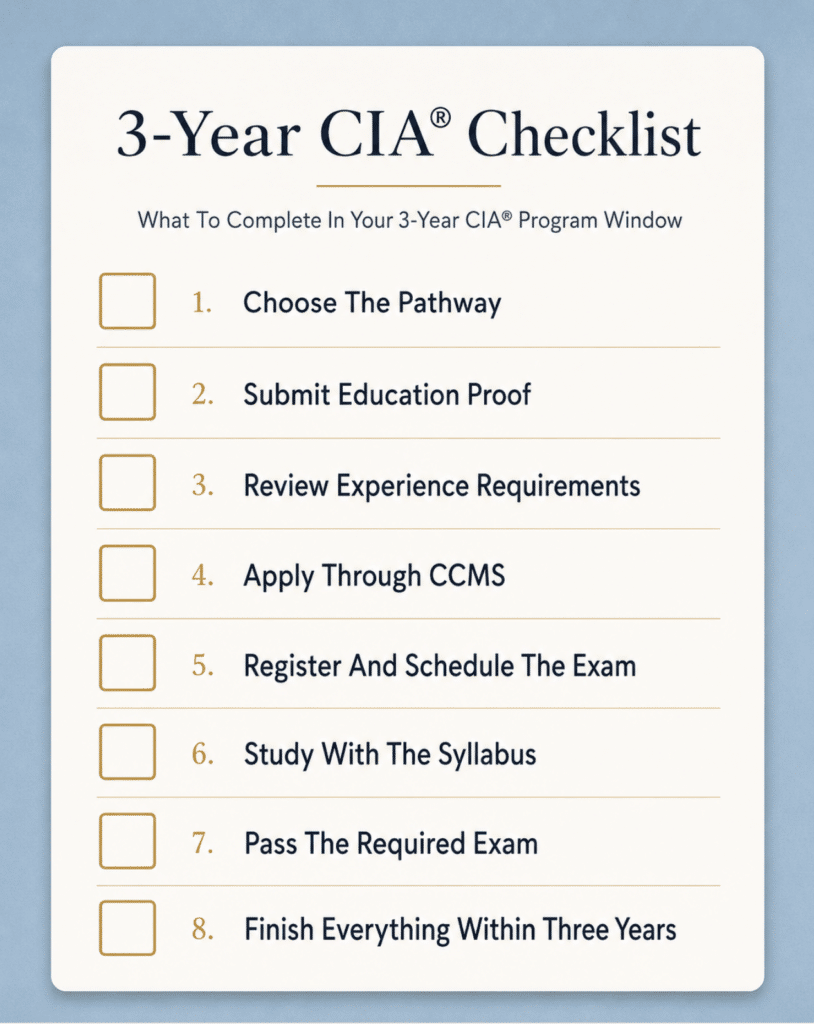
📝 Student Sticky Note: Keep the checklist above handy while working through the CIA® certification process, so the main steps and 3-year deadline are easy to follow
How to Study to Increase Your Chance of Passing
This is where the process turns from paperwork into performance. Applying and registering get someone into the CIA® process, but study habits are what decide how prepared they are on exam day.
A good CIA® study plan should include:
- Use The Syllabus: Treat it like the main checklist.
- Try a prep course: If you want more structure, check out our top CIA prep courses before you build your study plan.
- Prioritize Bigger Topics: Spend more time on topics where the exam does.
- Start Questions Early: Do not save practice questions for the end.
- Track Missed Questions: Turn weak spots into a review list.
- Time Yourself: Practice answering under exam pressure.
For a deeper look at one popular option, see our Becker CIA review.
If an exam part is failed, it can be retaken after the required waiting period and must be registered for again.
The Last Thing I’d Say About The CIA® Path
As a test prep reviewer, I’ve seen how easy it is for people to feel overwhelmed before they even start step one. That usually happens when the process feels like one giant mess of forms, exams, and deadlines.
Becoming a Certified Internal Auditor is easier to wrap your head around once the steps are in order. The smartest move is to slow down at the start, check the requirements, and make a plan that actually fits the timeline. With steady prep and one exam part at a time, the CIA® path feels a lot more manageable.
FAQs
To become a Certified Internal Auditor, applicants typically need education proof, relevant work experience, and a character reference. The exact requirements can depend on education level, background, and CIA® pathway.
The traditional CIA® exam has three parts: Internal Audit Fundamentals, Internal Audit Engagement, and Internal Audit Function. Each part tests a different area of internal auditing.
A steady study plan usually works best. Focus on one exam part at a time, use the CIA® syllabus as the main checklist, take timed quizzes, and review missed questions regularly.
Many people complete the CIA® process in 12 to 18 months, but the full program must be completed within three years.
Yes. Students and early-career professionals may be able to start through the Internal Audit Practitioner route or another pathway that fits their background.

Bryce Welker is a regular contributor to Forbes, Inc.com, YEC, and Business Insider. After graduating from San Diego State University, he went on to earn his Certified Public Accountant license and created CrushTheCPAexam.com to share his knowledge from reviewing hundreds of accounting courses while helping thousands of other accountants become CPAs. Bryce was named one of Accounting Today’s “Accountants To Watch” among other accolades. As Seen On Forbes