So, is the CIA exam actually as intimidating as it sounds?
The Certified Internal Auditor exam is the test you take to earn the CIA credential and move forward in internal audit
The exam sounds simple at first: pass the test, earn the credential, move into internal audit. But there’s more to it than just studying and testing. You’ll need to understand the three exam parts, IIA requirements, work experience rules, and even what happens after you pass.
Today, I’ll walk you through the key things to know about the CIA exam so you can decide if it fits your goals. Here’s everything you should know.
Key Takeaways
- CIA Focus: The CIA is built for internal audit, risk, controls, compliance, and governance.
- Exam Structure: You take three multiple-choice exam parts separately.
- Time Needed: Many candidates spend 100 to 150 study hours per part.
- Full Process: Passing the exam is not the only step; you still need to meet IIA requirements.
- Ongoing CPE: After earning the CIA, you need yearly CPE to keep it active.
The Basics: What Is The CIA Exam?
The CIA exam is the test you take to earn the Certified Internal Auditor credential from The Institute of Internal Auditors.
It is built for people who want to work in internal audit, risk, compliance, governance, or business controls. Instead of focusing on tax or public accounting, the CIA exam tests how well you understand risk, controls, ethics, audit work, and how organizations run from the inside.
The Three CIA Exam Parts
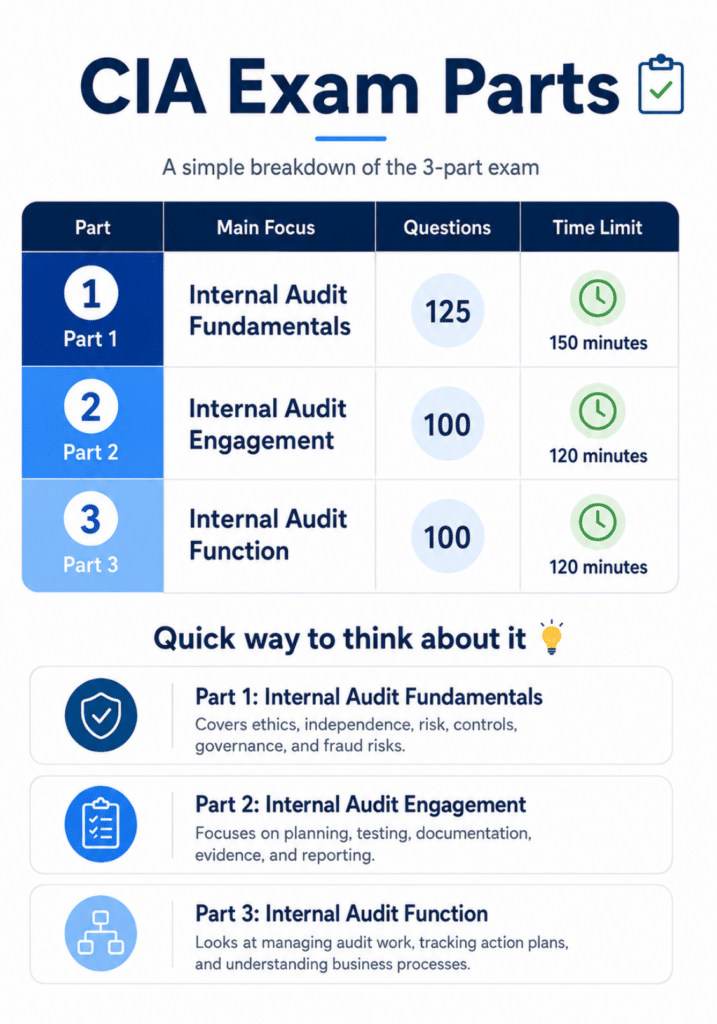
The exam has three parts and 325 multiple-choice questions total. Together, they cover internal audit fundamentals, audit engagement work, and the role of the internal audit function inside an organization.
| CIA Exam Part | Main Focus | Questions | Time Limit |
|---|---|---|---|
| Part 1 | Internal Audit Fundamentals | 125 | 150 minutes |
| Part 2 | Internal Audit Engagement | 100 | 120 minutes |
| Part 3 | Internal Audit Function | 100 | 120 minutes |
Here’s what each exam focuses on:
- Part 1: Internal Audit Fundamentals: Covers ethics, independence, risk, controls, governance, and fraud risks.
- Part 2: Internal Audit Engagement: Focuses on planning, testing, documentation, evidence, and reporting.
- Part 3: Internal Audit Function: Looks at managing audit work, tracking action plans, and understanding business processes.
Important Note: Each exam part is scored separately. If you pass one part, you keep that result while you work on the others. If you fail one part, you only retake that part after the required waiting period instead of restarting the full exam.
CIA Exam Paths
There are a few ways candidates may move through the CIA exam process, but most people take the standard three-part CIA exam.
- Traditional CIA Exam: The regular route for most candidates. It includes three exam parts.
- CIA Challenge Exam: A shorter one-exam route for candidates who already qualify through certain credentials or experience.
- IAP Pathway: An early pathway where Internal Audit Practitioner holders may receive a waiver for CIA Part 1.
💡 Pro Tip: If you are new to internal audit, focus on the standard CIA exam. If you already have related experience, IAP, or another qualifying credential, check whether an alternate exam path fits.
CIA Eligibility, Timeline, And Cost
Passing the CIA exam is a big step, but it is not the only thing you need to earn the credential.
In most cases, candidates need to meet these requirements:
- Entry Requirement: Meet one of the IIA’s CIA entry paths, such as a bachelor’s degree or equivalent, an active IAP designation, or qualifying professional experience.
- Experience Requirement: Complete a qualifying internal audit or related work experience.
- Exam Requirement: Pass all three CIA exam parts.
- ID and Character Requirements: Submit the required identification and character documents.
- Program Timeline: Complete the CIA program within three years, unless you receive an approved extension.
Most candidates complete the full CIA certification path in about 1 to 3 years, depending on their background, work experience, and study pace.
My step-by-step on how to become a certified internal auditor lays out that path in order.
The exams themselves can be finished in months if you stay consistent. The full credential may take longer if you are still building the required work experience.
CIA Exam Costs
The CIA exam is not free, but the exact cost depends on your IIA membership status, which path you choose, how many parts you take, and whether you buy study materials.
Current CIA prep discounts are collected on one page if you go the course route.
At a minimum, most candidates should plan for:
- Application fee
- Exam fees for each CIA exam part
- Study materials, textbooks, or one of the best CIA review courses
IIA members usually pay lower exam fees than non-members, so it may be worth comparing both options before applying.
| CIA Fee | IIA Member | Non-Member |
|---|---|---|
| Application Fee | $120 | $240 |
| Part 1 Exam Fee | $310 | $445 |
| Part 2 Exam Fee | $280 | $415 |
| Part 3 Exam Fee | $280 | $415 |
| Total Application + Exam Fees | $990 | $1,515 |
CIA Salary & Career Outlook
The CIA can help you move into work where companies trust you to spot problems, question weak processes, and help prevent expensive mistakes.
Common CIA-related roles include:
- Internal Audit
- Risk Management
- Compliance
- Financial Controls
- Advisory Work
For pay, the BLS reports a median annual wage of $81,680 for accountants and auditors. Internal auditor pay varies by industry, location, and seniority, with many roles falling around $65,000 to $120,000+.
CIA Exam Difficulty & How To Study For It
The CIA exam can feel difficult — the CIA exam pass rates confirm it is not a quick cram-and-pass test. You have three separate parts, timed questions, and months of studying to manage.
It gets easier when you treat each part like its own smaller exam, practice questions early, and track what you keep missing.
A realistic study plan usually means:
- 100 to 150 hours per part
- 2 to 4 months per part if you work full-time
- Extra time for Part 3 if broader topics feel harder
💡 Pro Study Tip: Use a CIA review course or current syllabus-based materials, then stick to a steady schedule with practice questions from the start. That gives you a better shot than trying to cram everything later.
How To Keep Your CIA Certification Active
Passing the exam is not the final “done forever” moment. After you earn the CIA, you have to keep the credential active with continuing education.
Practicing CIAs generally need:
- 40 CPE hours each year
- 2 ethics CPE hours each year
- Annual CPE reporting through the IIA
- Renewal during the IIA’s yearly reporting window
In short, once you earn the CIA, you still have to keep learning each year so the credential stays active.
Final Verdict
The CIA exam is not something most candidates finish overnight, but it can be a practical next step if you want to build a career in internal audit.
The biggest thing is knowing whether the credential actually matches the work you want to do. If you like reviewing processes, spotting risk, checking controls, and understanding how organizations run behind the scenes, the CIA path makes sense to explore because it is one of the clearest options for people who want to stay focused on internal audit, risk, compliance, and governance.
FAQs
The CIA exam includes Part 1: Internal Audit Fundamentals, Part 2: Internal Audit Engagement, and Part 3: Internal Audit Function.
Most candidates complete the full CIA certification path in about 1 to 3 years, depending on education, work experience, and study pace.
The CIA exam focuses on ethics, risk management, control, engagement planning, evidence gathering, communication, and managing the internal audit activity.
A realistic plan is about 100 to 150 hours per exam part, often spread over 2 to 4 months per part for working professionals.
Candidates generally need to apply to the program, meet an approved entry path, pass the required CIA exam parts, complete the IIA’s work experience requirement, and meet identification and character standards.

Bryce Welker is a regular contributor to Forbes, Inc.com, YEC, and Business Insider. After graduating from San Diego State University, he went on to earn his Certified Public Accountant license and created CrushTheCPAexam.com to share his knowledge from reviewing hundreds of accounting courses while helping thousands of other accountants become CPAs. Bryce was named one of Accounting Today’s “Accountants To Watch” among other accolades. As Seen On Forbes